PEP screening under the GwG: Who is politically exposed?
Politically exposed persons (PEPs) are subject to special due diligence obligations under § 1 Abs. 12 GwG. Ignoring this carries the risk of fines and personal liability. This guide shows who belongs to the PEP group and how to implement screening in a legally compliant way.
Who is politically exposed?
Under § 1 Abs. 12 GwG, PEPs are persons who hold or have held a "important public office at international, European, or national level" within the last 12 months.
The PEP group includes:
National and international politicians
Heads of state and government
Ministers, state secretaries, parliamentary state secretaries
Members of the Bundestag, state parliaments, and the European Parliament
Senior judges (Federal Constitutional Court, Federal Court of Justice, CJEU)
Senior military officers (from brigadier general / rear admiral upward)
Members of administrative, management, and supervisory bodies of state-owned companies
International officials
Senior officials of international organizations (UN, European Commission, World Bank, IMF)
Ambassadors and chargés d'affaires
Family members of PEPs
Spouses or comparable life partners
Children and their spouses
Parents
Known close associates
Business partners (especially in joint economic ventures)
Other persons with a close business or personal relationship
Who must perform PEP screening?
According to § 2 GwG, the following companies are required to do so:
Credit institutions and financial institutions
Insurance companies (life insurance)
Investment management companies
Payment institutions, e-money institutions
Financial investment intermediaries, fee-based financial investment advisors
Real estate agents (for transactions from €10,000)
Lawyers, tax advisors, auditors (for certain mandates)
Goods dealers (for cash transactions from €10,000)
Art dealers, art intermediaries (from €10,000)
What are the enhanced due diligence obligations?
For PEPs and their family members / close associates, enhanced due diligence obligations apply under § 15 GwG:
Management approval: The business relationship must be approved by senior management or a manager designated by it
Clarify the source of funds: Appropriate measures must be taken to determine the source of assets
Enhanced ongoing monitoring: The business relationship must be monitored more closely
How often must checks be performed?
Before entering into a business relationship: Identify the person as a PEP and complete the approval process
Before hiring (for pre-employment screening): Integrate into the background check process
Ongoing: At least quarterly, preferably monthly. Reason: PEP status can change (a person is elected to office)
Why manual PEP checks do not scale
PEP databases are updated continuously. Worldwide, there are hundreds of thousands of PEPs, family members, and close associates. Manual research via Google is not enough:
Not all PEPs have Wikipedia entries
Family members are difficult to identify
Name variations and alias names are nearly impossible to capture manually
Ongoing monitoring is unthinkable without automation
Commercial PEP databases
Professional PEP databases contain:
Current global PEP entries
Family members (partners, children, parents)
Known close associates
Historical data (PEP status in the last 12 months)
Fuzzy matching for name variations
Leading providers: Moody's, LexisNexis WorldCompliance, Refinitiv World-Check, Dow Jones Risk & Compliance.
PEP screening in Switzerland, Austria, and across the EU
Switzerland — GwG and FINMA circulars
Switzerland has its own Anti-Money Laundering Act (GwG, SR 955.0). PEP definition in Art. 2a GwG: foreign PEPs, domestic PEPs, and PEPs of international organizations. For financial intermediaries, FINMA Circular 2016/7 (or the current version) applies with detailed due diligence obligations. Special feature: Switzerland distinguishes more sharply between foreign PEPs (generally "higher risk") and domestic PEPs (risk-dependent).
Austria — FM-GwG + BWG
In Austria, the Financial Market Anti-Money Laundering Act (FM-GwG) applies, with § 2 Z 6 as the central PEP definition. For banks, § 40 BWG applies in addition. Supervisory authority: FMA. Austria's implementation is more closely aligned with EU directives, which makes harmonization easier for multinational institutions.
Across the EU — AMLD + AMLR
The current 6th Anti-Money Laundering Directive (6AMLD) will be replaced in 2027 by the directly applicable Anti-Money-Laundering Regulation (AMLR). Together with the new AMLA (Anti-Money Laundering Authority) in Frankfurt, this creates an EU-wide supervisory system. PEP lists will be harmonized as a result, and the obligation for ongoing monitoring will become stricter.
Indicium PEP screening in practice
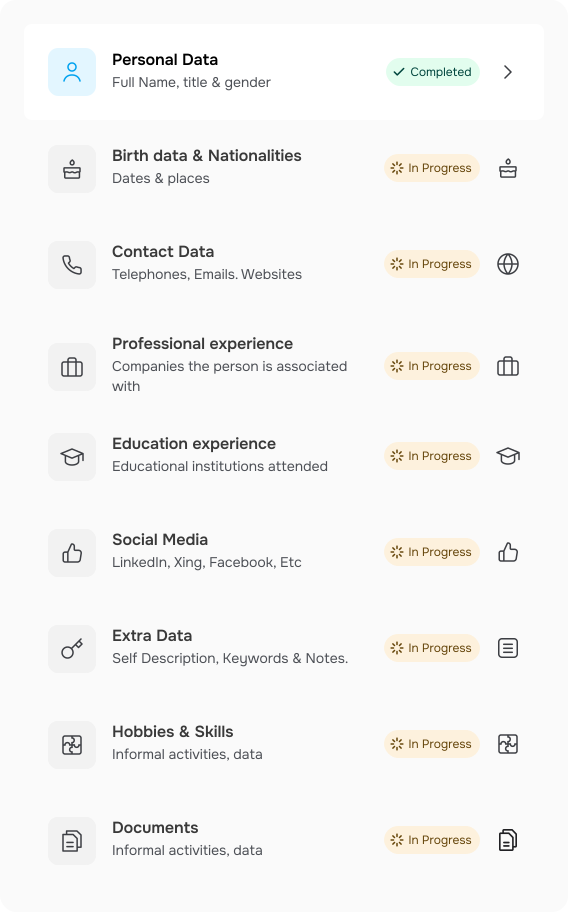
Indicium uses integrated PEP databases and automatically checks:
Candidate against global PEP list
Family members (when data is available)
Close associates (through cross-references)
Ongoing monitoring after hiring (configurable weekly or monthly)
Result: audit-proof documentation for BaFin audits, FIU inquiries, and internal audit.
What to do when there is a PEP match?
Do not reject automatically — PEP status is not a rejection ground per se
Review: What role does the person play? Are they a foreign PEP or a domestic PEP (different levels of strictness)?
Obtain approval: Senior management must approve the business relationship
Document the source of funds: Obtain evidence and document it
Intensify monitoring: Monitor PEP transactions closely
Common mistakes
Only checking national PEPs
Many companies only check German PEPs. But foreign PEPs, EU Commissioners, and UN officials are also covered.
Overlooking family members
The spouse of a PEP is themselves a PEP under the GwG. Children, parents, and partners must also be checked.
One-time screening
PEP status can change at any time. Ongoing monitoring is mandatory.
No documentation
If the FIU (Financial Intelligence Unit) asks, it must be possible to prove: when was whom checked against which list?
Conclusion
PEP screening is technically demanding and legally mandatory for many industries. Manual checks do not scale. Automated, ongoing monitoring with audit-proof documentation is the only practical approach.
Book a demo and see how Indicium integrates PEP screening into your hiring process.
Read more — related articles
Nabil El Berr

Diesen Artikel gelesen? Sprich 30 Min mit unserem Head of Sales.
Die hier beschriebenen Prüfungen automatisiert Indicium: DSGVO-konform, EU/Schweizer Hosting, audit-fester Trail, Reports in 8–30 Minuten. Drei Insight-Essential-Reports kannst Du ohne Kreditkarte testen.
Mabon Hein, Head of Sales · 30 Min · Keine Sales-Pitch