Startup CEO Background Check: What Top Funds Expect from Portfolio Companies
In the seed stage, the Karpathy principle applies: „You bet on the founder." In Series A, the logic changes — now it’s: „You stress-test the founder." What until a few years ago only became standard practice starting in Series B is gradually moving forward in 2026. Systematic founder screening is not a vote of no confidence, but institutional diligence — and a litmus test for the professionalization of Europe’s VC landscape.
Why screening comes into play later than in private equity — and is now moving forward
The time lag has a structural logic. In the seed stage, the founder is the investment object. A systematic background check at a time when the team consists of two people and a prototype feels disproportionate. From Series A onward, the calculus changes: the CEO leads a team of 30 to 50 people, is responsible for capital in the low single-digit millions, and the transaction costs of a mistake — write-down, management restructuring, down round — justify the effort.
But a shift is visible: funds such as Sequoia Capital, Benchmark, Andreessen Horowitz (a16z), and Accel are already starting to use systematic integrity checks in the seed phase. The reason is empirical: fund-pool economics do not scale linearly. A single fraud case in the portfolio costs more than 300 clean seed screenings combined. European top funds such as Atomico, Index Ventures, Creandum, Lakestar, Earlybird, HV Capital, and Cherry Ventures are increasingly following this logic — with European specificities we will look at shortly.
What top funds actually check
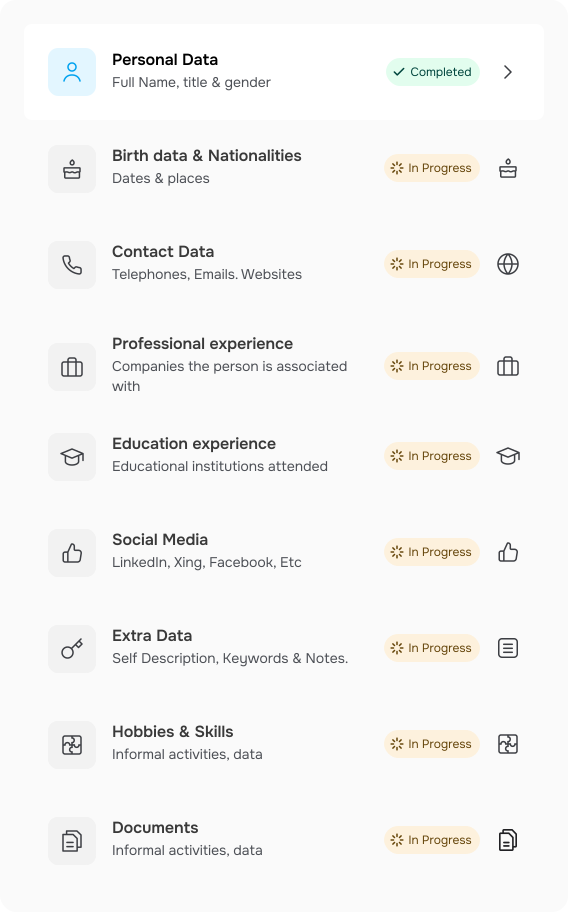
A systematic pre-Series-A founder DD goes well beyond CV verification and identity checks. Observations from portfolio conversations with institutional VCs over the past 18 months show a standard set of 20 data points that has become the institutional minimum.
Identity verification via eID or certified video identification.
Academic degrees verified directly with the issuing institution.
CV timeline consistency: no unexplained gaps, no overlapping full-time roles.
Previous employer references, structured also around reasons for leaving.
Corporate office history: all previous managing director, board, and supervisory board mandates.
Exit patterns of prior ventures: liquidation, asset sale, insolvency, squeeze-out, positive exits — with qualitative classification.
Prior-company dissolutions: details of any insolvency challenge proceedings, Section 64 GmbHG proceedings, Article 754 OR claims.
Cap table conflicts: ongoing or past shareholder disputes, vesting disputes, shareholder exclusion proceedings.
Sanctions list screening: EU, OFAC, UN, SECO, OFSI.
PEP status: including first-degree relatives and close business partners.
Adverse media in national and industry media over the past ten years.
Social media screening: publicly accessible profiles for reputation-relevant signals, structured and without evaluating private lifestyle choices.
Litigation profile: civil and, where permitted, criminal proceedings.
Creditworthiness signals: business reports, no personal insolvency in the last ten years.
Competing interests: active or historical stakes in competitors.
IP risks: potential IP conflicts with former employers.
Investor references: feedback from previous investors, collected in a structured way.
Co-founder relationships: documented conflicts, exits from the founding team.
Advisory mandates: potential conflicts of interest from boards and advisory roles.
Regulatory status: relevant sector-specific licensing or exclusion proceedings.
How European funds differ from US funds
The Atlantic divide in founder DD is both structural and cultural. Three differences shape European practice.
First, second-time founder due diligence is deeper in Europe. While US funds often treat a successful serial entrepreneur as a self-recommendation, European funds — above all Index Ventures and Atomico — also require structured checks of earlier corporate relationships for established founders. The reason is regulatory: in many European jurisdictions, liability-relevant details of previous mandates are publicly accessible, but only if actively requested. That creates a duty of care that looks different from the US, where transparency is lower.
Second, less weight is placed on Stanford-network proxies. US funds compensate for missing background data at least in part through social certification: Stanford degree, Y Combinator batch, well-known advisor. European funds operate with less homogeneous elite infrastructure and therefore need more robust data points. That leads to earlier, structured screening — and makes European founders better prepared for the review.
Third, greater GDPR sensitivity. What is routinely covered in Delaware-based funds through disclosure standards requires an explicit consent architecture in Europe. That doesn’t change the depth of the DD, but it does change how it is operationalized: founders must be treated as independent data subjects, not as attributes of their company.
GDPR boundaries: what a VC may do — and what not
The GDPR sets a clear framework for founder screening. The distinction between processing that does not require consent and processing that does is not trivial in practice.
For rule-based standard checks — commercial register searches, sanctions list screening, publicly accessible adverse-media research, PEP status — Art. 6 para. 1 lit. f GDPR applies (legitimate interest). The investor has a comprehensible and documentable interest in checking the integrity of potential portfolio CEOs, and the relevant data sources are public or semi-public. Important: the legitimate interest must be documented and balanced against the founder’s interests (Legitimate Interest Assessment, LIA).
For special categories of personal data under Art. 9 GDPR — health data, political opinions, religious beliefs, sexual orientation, trade union membership — legitimate interest is not enough. Explicit consent under Art. 9 para. 2 lit. a GDPR is required. In practice, this is especially relevant for social media screening: as soon as political or ideological content is evaluated, the strict consent requirement applies.
For criminal data under Art. 10 GDPR, national special rules apply. In Germany, processing is generally only permitted under strict conditions; the relevant standard comes from Section 26 BDSG for employment relationships and can only be applied to founder screenings in a limited way. In Switzerland, Art. 31 FADP (revised 2023) applies with comparable restrictions.
How founders can protect themselves — and what counts as fair
During the DD phase, founders face an information asymmetry that can be reduced by a few basic rules. What is accepted as fair and market-standard follows a clear pattern:
Context-specific, documented DD is fair. A standard set of publicly accessible data points, collected in a structured way, with a clear duty to inform the founder — that is institutional diligence.
Consent-based deep checks are fair when they are announced transparently and tied to a clear purpose.
Social media screening of private profiles without consent is intrusive and not market standard. Public professional profiles (LinkedIn, Xing, public Twitter/X accounts) are permitted.
Questionnaires about health, family planning, or political views are not only contrary to GDPR, they are also a warning sign about the fund itself. Serious investors do not use such practices.
One-sided onward processing without purpose limitation — for example, sharing DD results with other funds in the portfolio — is not permitted and is not market standard.
The most important countermeasure is transparency. Founders who proactively bring a documented integrity report themselves significantly shorten the DD phase and position themselves as an institutionally reliable partner. Tools like Indicium explicitly support this founder-initiated flow.
Post-closing: when the portfolio company becomes regulated
One often overlooked point: the screening obligation does not end with the term sheet. Once a portfolio company scales into a regulated sector — payments, banking, crypto custody, health data, critical infrastructure — sector-specific fit-and-proper regimes kick in, which require documented integrity checks. BaFin requires a structured suitability assessment of management for e-money licenses, payment institution licenses, and activities regulated under the German Banking Act (KWG). If you cannot produce an audit trail at that point, you lose months in the licensing process.
What applies in Switzerland, Austria, and across the EU?
Switzerland: FINMA for FinTech portfolios
The FINMA, with the FinTech license under Art. 1b of the Banking Act (BankG), has created a low-threshold regime that still requires assurance of proper business conduct. For Swiss VCs with FinTech portfolios — especially Lakestar and established funds on the Swiss side — founder integrity checks are also part of regulatory preparation. The revised Swiss Data Protection Act (FADP, in force since 1 September 2023) largely harmonizes the framework with the GDPR without fully mirroring it. Art. 31 FADP governs the processing of particularly sensitive personal data, Art. 19 FADP the information obligations toward the data subject.
Austria: FMA for portfolio finance subsidiaries
The FMA checks both the ownership structure and management of Austrian financial portfolio subsidiaries. Ownership control under Section 20 BWG and Section 11a WAG requires structured background checks of significant shareholders — including VC funds with stakes above 10 percent. The Austrian Data Protection Act (DSG 2018) supplements the GDPR with specific rules on personality rights. The VbVG additionally creates organizational liability, which requires due diligence in the selection of corporate officers at company level.
Across the EU: GDPR, AMLR, AI Act
The GDPR provides the uniform framework. The AMLR — applicable from July 2027 — expands KYC obligations to obliged entities in the broader sense and directly affects parts of the VC ecosystem. The EU AI Act hits VCs at an unexpected point: if AI-based personality scoring tools are used for founder assessments — a growing trend in the US scene — VCs become deployers of high-risk AI systems within the meaning of Annex III of the AI Act. That means documentation obligations, transparency statements toward the founders being assessed, and a conformity assessment. Anyone introducing a talent screening tool today without thinking through these obligations risks fines in 2027 of up to 15 million euros or 3 percent of global annual revenue.
Indicium: invite-based workflow, 48-hour turnaround, privacy by design
Indicium operationalizes founder screenings with three design principles that directly address European VC requirements.
First, the invite-based workflow: the fund invites the founder, the founder initiates the review independently, and the necessary consents under Art. 6 para. 1 lit. a and Art. 9 para. 2 lit. a GDPR are granted in a structured and traceable way. No hidden screening, no unclear mix of legal bases — just a clear, documented process that remains robust even in a very late dispute.
Second, 48-hour turnaround: the standard report is ready two working days after the founder’s approval. That shortens DD cycles, which typically take three to five weeks, by crucial days and supports competitive deal-flow situations.
Third, privacy preserving by design: server location in Germany and Switzerland, data minimization under Art. 5 para. 1 lit. c GDPR, integrated consent management with granular purpose limitation, technical and organizational measures under Art. 32 GDPR, automated deletion concept under Art. 17 GDPR. The founder retains control over the data and can also reuse the report with follow-on investors — an efficiency gain for the entire European VC ecosystem.
Startup CEO background checks are not a vote of no confidence in 2026; they are institutional standard practice. The question is no longer whether, but how. Any VC that establishes a structured, GDPR-compliant process today gains trust from founders, saves time in DD, and secures legal certainty vis-à-vis LPs.
Book a demo and see how Indicium delivers founder screenings in 48 hours in a GDPR-compliant way — without losing transparency or trust with the target.
Read more — related articles
Nabil El Berr

Diesen Artikel gelesen? Sprich 30 Min mit unserem Head of Sales.
Die hier beschriebenen Prüfungen automatisiert Indicium: DSGVO-konform, EU/Schweizer Hosting, audit-fester Trail, Reports in 8–30 Minuten. Drei Insight-Essential-Reports kannst Du ohne Kreditkarte testen.
Mabon Hein, Head of Sales · 30 Min · Keine Sales-Pitch