Private Equity Operational Due Diligence: Background Checks as Standard
Operational Due Diligence (ODD) has evolved over the last ten years from an add-on into a core component of every private equity transaction. What began as a purely financial analysis now covers commercial market logic, legal risks, and increasingly the personal integrity of target management. For operating partners, portfolio ops teams, and interim CEOs, screening individuals is no longer a compliance checkbox exercise, but a central value driver over the holding period.
From Financial DD to Integrated Operational DD
The classic DD cascade follows a clear evolution: Financial DD (numbers, audits, working capital), Commercial DD (market position, competition, customer satisfaction), Legal DD (contracts, litigation, reps and warranties), and finally Operational DD (processes, IT, governance, personnel). Over the last three to five years, a fifth area has become established: Integrity DD, meaning the systematic review of target executives for personal risk indicators.
Top-tier firms such as KKR, Blackstone, EQT, and CVC Capital Partners have developed ODD frameworks that treat integrity checks not as an afterthought, but as a structural element across the entire investment lifecycle. EQT explicitly refers in its ops playbook to “management fit across integrity, capability, and alignment” as a three-part standard. KKR embeds regular portfolio CxO reviews in its KKR Capstone model, systematically capturing integrity signals.
The reason is economic: according to a 2024 analysis by Bain & Company, around 23 percent of failed PE deals are attributable to management issues, and a meaningful share of those stem from integrity topics that would have been uncovered through systematic screening. In an environment with declining multiple arbitrage and increasing pressure to generate operational alpha, any avoidable value destruction caused by personnel risk is a breach of duty toward LPs.
The Four Phases of Integrated PE Integrity DD
A robust framework does not treat integrity checks as a one-time event at signing, but as a continuous process throughout the entire holding period. Four phases have become established.
Phase 1: Pre-Close Screening (5-10 days before signing)
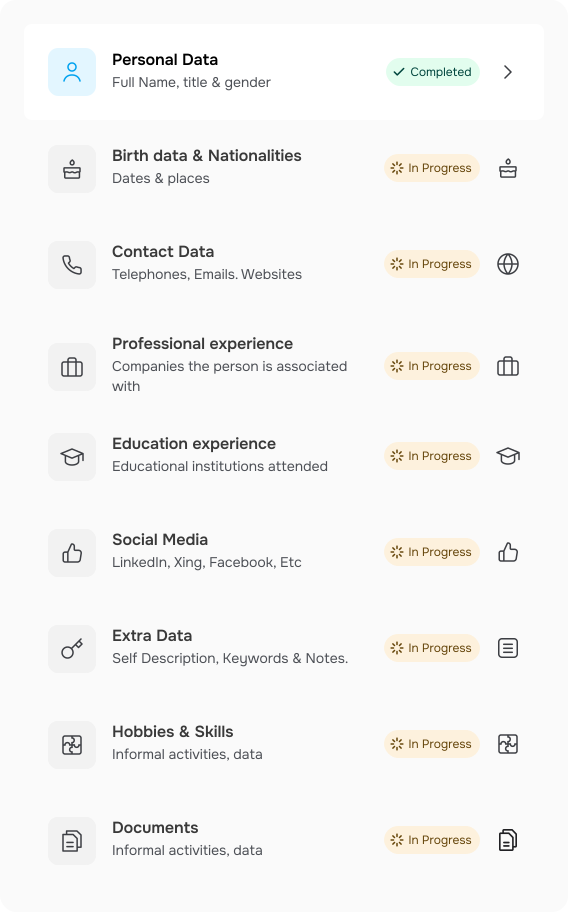
In the final DD phase, the core management team — typically CEO, CFO, COO, and the one or two most important VPs — undergoes an in-depth background check. Turnaround time: 72 hours. Scope:
Identity verification: eID-based or via certified video identification.
CV verification: academic degrees, previous positions, overlapping mandates.
Managing director history: prior board roles, insolvent companies, liability-relevant incidents.
Sanctions lists: EU, OFAC, UN, Switzerland (SECO), UK (OFSI).
PEP status: politically exposed persons under the FATF definition, including relatives and close business associates.
Adverse media: structured media research in national and industry publications from the last five years.
Litigation profile: civil and publicly accessible criminal proceedings.
Phase 2: 100-Day Plan and Management Upgrade DD
Most PE deals involve personnel changes in the first 100 days: a new CFO, creation of a Chief Strategy Officer role, reinforcement of sales leadership. Every one of these hires goes through the same screening path as the pre-close management team. In practice, that means between three and eight executive-level screenings in the first four months after closing. Without standardized tooling, this becomes a permanent organizational burden for the portfolio ops teams.
Phase 3: Hold-Period Monitoring (quarterly)
The holding period is not a vacuum. CxOs marry into politically exposed families, become shareholders in new businesses, get caught up in sanctions lists through private activities, or their home country experiences geopolitical shifts that make them PEP-relevant overnight. Quarterly rescreening of the entire portfolio leadership team captures these dynamic risks. In a mid-market fund with 15 portfolio companies and an average of six key CxOs per investment, that amounts to roughly 360 monitoring events per year — impossible to handle with acceptable quality without tooling support.
Phase 4: Exit Preparation (12 months before sale)
Twelve months before the planned exit, the clean-up DD begins. Each CxO is documented once again in full — not primarily for internal purposes, but for the data room setup. Strategic buyers and IPO underwriters increasingly require integrity evidence as part of the vendor due diligence package. A clean audit trail covering all screening events during the holding period is both a sales argument and a driver of price.
Typical Red Flags in PE Portfolio CxO Hiring
Not every issue is a dealbreaker, but every issue requires structured assessment. From practice over the last three years, three clusters have proven critical:
Unknown network connections: The candidate is a minority shareholder in a holding company that in turn holds stakes in competitors or suppliers of the target. Not prohibited — but disclosure and conflict-of-interest management are required.
Historical managing director liability: Insolvency challenge actions, section 64 GmbHG proceedings (Germany), Article 754 CO liability claims (Switzerland). A single case may be explainable; a pattern across multiple prior mandates is a structural indicator.
Insolvency proximity: The candidate served within the last 24 months as an officer of a company that filed for insolvency — even if they are not personally liable. Not automatically disqualifying, but it requires context.
Hold-Period-Specific Risks
The dynamic risks of the holding period are systematically underestimated in practice. Three real-world cases from 2024/2025:
CEO becomes a PEP through marriage: A DACH portfolio CEO marries a managing director of a regional bank. From that moment, he becomes PEP-relevant under GwG and FATF standards — with significant implications for the portfolio company’s banking relationships.
CFO becomes sanctions-relevant: The portfolio CFO is privately a shareholder in a Russian tech company. After the adoption of the 14th EU sanctions regulation, he falls into a sanctions context — with immediate implications for continuing in his role.
COO adverse media event: An investigative media report sheds light on the COO’s private business activities from the 2010s. Without systematic monitoring, the PE investor learns about it only from the press — with maximum reputational damage.
Risk Matrix as an Operating Tool
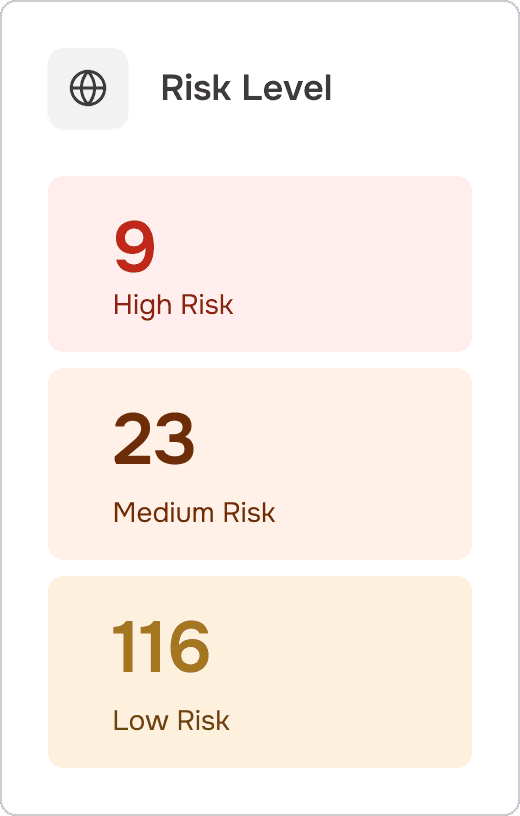
In practice, ops teams work with a standardized risk matrix that classifies each portfolio CxO into one of four risk categories. The matrix is updated for each screening event and feeds into the quarterly ops reviews.
Risk class | Characteristic | Monitoring frequency | Reporting level |
|---|---|---|---|
Green | No issues, stable life events | Annually | Portfolio Ops Team |
Yellow | Isolated incidents, fully clarified | Semi-annually | Operating Partner |
Amber | Structural issues or dynamic risk | Quarterly | Managing Director |
Red | Current sanctions, PEP, or litigation relevance | Monthly | Investment Committee |
CSRD, EBA-ESMA, and Regulated Portfolio Targets
The regulatory wave over the next 18 months is shifting integrity checks from best practice to hard obligation. Three frameworks are immediately relevant for PE firms:
The Corporate Sustainability Reporting Directive (CSRD) applies from the 2025 reporting year to companies with more than 250 employees, EUR 50 million in revenue, or EUR 25 million in total assets. As part of governance reporting under ESRS G1, explicit disclosure of compliance processes to prevent corruption and bribery is required — including integrity due diligence at executive level. For PE firms with portfolio companies in this size range, that means the CSRD wave reaches the portfolio, and reporting must be consolidatable at fund level.
The EBA Guidelines on Suitability (EBA/GL/2021/06) and the parallel ESMA Suitability Guideline define fit-and-proper requirements for the management bodies of regulated financial institutions. For PE firms with portfolio companies in the regulated financial sector — payment service providers, BaFin-supervised asset managers, FinTechs with e-money licenses — the integrity criteria defined there apply directly. The 2024 version tightens the requirements for ongoing reviews during the term of office in particular.
The Digital Operational Resilience Act (DORA) — fully applicable since 17 January 2025 — requires structured people governance processes for financial targets, including integrity monitoring of operational management. The parallel NIS2 Directive brings comparable requirements for portfolio companies in critical infrastructure. If you invest as a PE firm in regulated sectors, a systematic integrity framework is no longer optional.
What Applies in Switzerland, Austria, and Across the EU?
Switzerland: FINMA Regime and Liability Law
Swiss supervision operates with a dual model. Regulated portfolio companies — especially FINMA-supervised asset managers, banks, insurers, and fintech license holders — are subject to FINMA Circular 2017/1 “Corporate Governance — Banks” and the parallel regimes for other financial institutions. The fit-and-proper requirements are strictly formalized through Art. 3 para. 2 lit. c of the Banking Act, Art. 14 of FINIG, and the analogous rules for insurers. Non-FINMA portfolios are free, but they remain subject to general liability law under Art. 754 CO and the duty of care under Art. 717 CO — both involving personal liability of the governing bodies in the event of breach. The revised Swiss company law (in force since 1 January 2023) has further tightened documentation requirements for due diligence processes.
Austria: FMA, BörseG, and Strict Liability Law
The Austrian Financial Market Authority (FMA) scrutinizes owners and management of financial holdings rigorously. For PE investments in Austrian credit institutions or investment firms, the ownership control procedure under Section 20 BWG or Section 11a WAG applies. In addition, the Association Liability Act (VbVG) extends criminal organizational liability to failures in selecting officers: anyone who appoints an unverified CxO and thereby enables a compliance incident may be criminally liable at the level of the association. For portfolio finance subsidiaries with an Austrian parent company, the background check standard is effectively mandatory.
Across the EU: GDPR, AMLR, and AI Act
Across Europe, the GDPR provides the framework for processing personal data in the screening context. The legal basis is Art. 6(1)(f) GDPR (legitimate interest) — and for data relevant to criminal offenses, Art. 10 GDPR also applies, together with strict national special rules. The new Anti-Money-Laundering Regulation (AMLR) — valid from July 2027 — harmonizes KYC/PEP screening standards across the EU and ties PE funds more closely to systematic integrity checks in the portfolio. The EU AI Act — effective in its first stages since 2 February 2025 — classifies personal risk-scoring systems as high-risk AI if they go beyond rule-based checks. Anyone using AI-based personality scoring in screening is a deployer within the meaning of the AI Act, with corresponding documentation and transparency obligations.
How Indicium Supports PE Operations Teams
A PE firm with 20 portfolio companies, an average of five key CxOs per investment, and quarterly monitoring reaches 400 screening events per year. Run manually, this ties up at least one full-time equivalent compliance FTE. Indicium standardizes this process with three core functions.
First, Bulk Enrollment: new portfolio CxOs are invited through a structured workflow, complete identity verification and consent declaration under Art. 6(1)(a) GDPR on their own, and the portfolio ops team receives a standardized integrity dossier within 72 hours. Second, Standardized Reports: each dossier follows a uniform structure that can be transferred directly into the investment memo or the 100-day plan. Third, Audit Trail: every screening event, every PEP query, and every sanctions check is versioned and stored in a tamper-proof manner. For the exit data room setup, that means a complete record of integrity governance across the entire holding period — as a value argument at sale.
GDPR compliance is not a feature here, but a design principle. Server locations in Germany and Switzerland, data minimization under Art. 5(1)(c) GDPR, integrated consent management, deletion concept under Art. 17 GDPR. For European PE firms with an LP base in the institutional segment, this is not a nice-to-have, but a prerequisite for use.
Operational due diligence without structured integrity screening is no longer a serious option in 2026. The regulatory wave from CSRD, DORA, NIS2, and AMLR turns best practice into an obligation. If you invest now, you build an operational edge that the competition will have to catch up with in 18 months.
Book a demo and see how Indicium operationalizes the integrity framework for your portfolio in 30 days.
Read more — related articles
Nabil El Berr

Diesen Artikel gelesen? Sprich 30 Min mit unserem Head of Sales.
Die hier beschriebenen Prüfungen automatisiert Indicium: DSGVO-konform, EU/Schweizer Hosting, audit-fester Trail, Reports in 8–30 Minuten. Drei Insight-Essential-Reports kannst Du ohne Kreditkarte testen.
Mabon Hein, Head of Sales · 30 Min · Keine Sales-Pitch