Hollywood vs. Reality: What Background Checks in Europe Really Mean
Think of a background check. What image appears in your mind's eye? A private detective in a trench coat sitting in a car with a telephoto lens? Or an analyst secretly rifling through the depths of private photo albums?
These images are culturally deeply ingrained in us – shaped by U.S. crime dramas. But for HR leaders in the DACH region, these clichés are misleading. They fuel the fear that every check falls into a legal gray area. The result: many companies would rather check nothing at all than make a mistake.
But looking away is not a strategy. The reality in Europe is less dramatic, but more efficient and smarter. Anyone who wants to understand modern Pre-Employment Checks must understand the difference between "curiosity" and "risk management". And yes: social media also plays a legitimate role here – if you use the right tool.
The cultural divide: discovery vs. data minimization
In the U.S., employers often act like investigators ("digging up dirt"). In Europe, lawmakers protect privacy. The GDPR and the Federal Data Protection Act (BDSG) draw clear lines. The guiding principle is: data minimization and necessity.
But that doesn't mean you have to hire blind. On the contrary: you have a legitimate interest in preventing harm to your company. The crucial difference lies in the approach:
Manual stalking (risk): You google the applicant yourself. In doing so, you inevitably see vacation photos, maybe learn about a pregnancy or political preferences. You now know things you are not allowed to know for assessing suitability. That makes you vulnerable to discrimination claims (AGG), because you cannot "unsee" what you have seen.
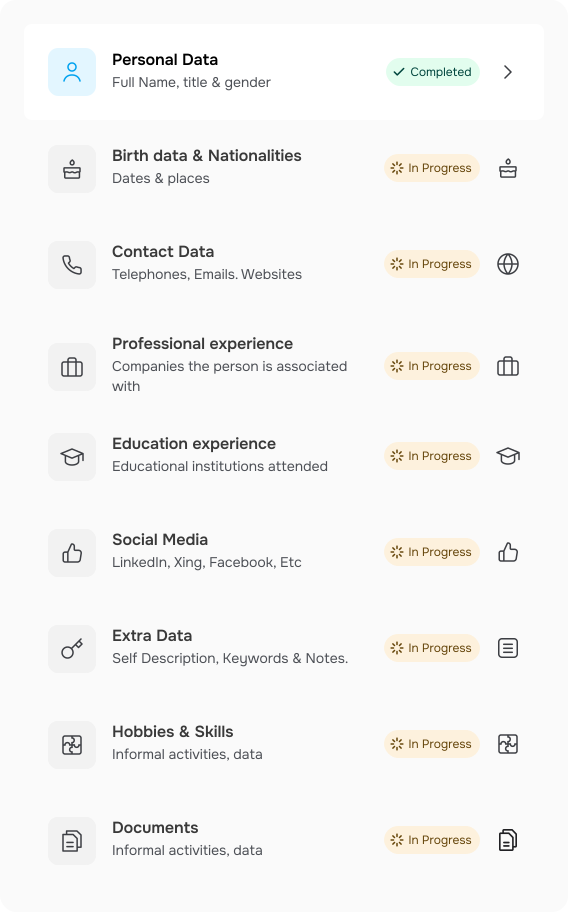
Professional validation (safety): Software checks the data neutrally. Only what is relevant for the job is filtered out (e.g., public racist statements for a representative role or negative press reports). The HR manager only sees the result ("Risk: Yes/No"), not the person's private life.
The "European Way": Reputation checks are possible
A persistent myth is that social media is completely off-limits for employers. That is not entirely correct. It depends on the context.
If you are hiring a spokesperson or a sales manager, that person's public persona becomes part of your brand. This is where the argument of reputational risk comes into play. Public statements (e.g., hate speech, extremist content) on platforms like X or LinkedIn are no longer purely private matters if they can reflect back on the employer.
But: the end does not justify every means.
Professional networks (LinkedIn/Xing): A check is almost always permissible here, as the data serves professional self-presentation.
Public data (adverse media): What an applicant has "obviously made public" (Art. 9 GDPR) or what has been reported about them (press) may be checked under certain conditions – if it is relevant for the role.
Consent: The safest route is transparency. Anyone who tells candidates upfront that a "media check" will be carried out for adverse media reports or reputational risks, and obtains their consent, builds trust and legal certainty.
Indicium acts as your shield here: we enable these checks without getting you tangled up in the fine print of data protection pitfalls.
What is allowed? A practical guide
Uncertainty arises from lack of knowledge. To give you orientation, we have translated the most common check points into a traffic-light logic.
Checklist: Do's and Don'ts in DACH recruiting
Use this overview to calibrate your processes. What is standard, what is possible, what is off-limits?
Green: The Do's – standardized validation
These data are the foundation of every professional hire.
Identity verification: Is the person who they claim to be? (Basic protection against identity fraud).
Qualifications: Does the doctorate really exist? Do the university degrees match? (Protection against impostors).
Professional track record: Was the candidate really Head of Sales at company XY for 5 years?
Yellow: The Smart Checks – doable with the right tool
Here lies often the greatest risk potential for companies – but also the greatest legal uncertainty when doing it yourself.
Social media & reputation: Permissible in cases of relevant risk exposure (e.g., representational duties). Important: Use software, not Google. Software filters out protected characteristics (religion, origin) and only flags real risks (glorification of violence, fraud, adverse media).
Financial integrity (creditworthiness/insolvency): Legitimate for positions with budget responsibility or in the financial sector (anti-money laundering prevention).
Sanctions lists & PEP status: Often even required by law in B2B and banking environments (compliance).
Red: The Don'ts – the red line
This is where the employer's interest ends.
Private communication: Closed Facebook groups or private Instagram stories are nobody else's business.
Health data: Diagnoses are off-limits (except when the activity is directly endangered, as determined by an occupational physician).
Unprotected manual research: If you browse Facebook yourself and reject the applicant because of a photo, you make yourself vulnerable.
Conclusion: Technology creates legal certainty
Anyone hiring employees today operates in a tension between duty of care (protecting the company) and data protection (protecting the applicant).
Many HR teams try to solve this dilemma with gut feeling. That is risky. A specialized solution like Indicium resolves the conflict technically: we give you the information without violating the privacy.
You learn that there is a risk – but you do not have to scroll through private profiles yourself. That is the "European Way": maximum security with maximum decency.
Background Checks are not a Hollywood drama. They are a hygienic standard process for modern companies — and studies show that resume lies are far more common than most people assume.
Further reading — related articles
"Many consider background checks to be legally risky. However, when done correctly, they protect companies from making poor decisions. Here is a guide to GDPR-compliant social media checks, reputation management, and the distinction between 'stalking' and 'validation'."
Nabil el Berr, CEO

Diesen Artikel gelesen? Sprich 30 Min mit unserem Head of Sales.
Die hier beschriebenen Prüfungen automatisiert Indicium: DSGVO-konform, EU/Schweizer Hosting, audit-fester Trail, Reports in 8–30 Minuten. Drei Insight-Essential-Reports kannst Du ohne Kreditkarte testen.
Mabon Hein, Head of Sales · 30 Min · Keine Sales-Pitch