The Trust Paradox: Why Background Checks Are Part of Good HR Work
In the corridors of European HR departments, the term “background check” still often triggers a vague sense of unease. It sounds like American-style mistrust, like private investigators and a culture of surveillance. But that concern is based on a fundamental misunderstanding. When companies check today, they do so not out of suspicion toward candidates, but out of loyalty to their own company. It is time to reassess the idea of “control.”
Trust is the most important currency in business. Especially in highly regulated industries such as banking or insurance, integrity is not a “nice-to-have,” but the operational foundation of the business. And yet many leaders hesitate to systematically validate the information candidates provide. Their concern: that they might sever the delicate bond built in the interview through bureaucratic rigidity.
At Indicium, however, we are seeing the opposite trend: when implemented properly, verification becomes a “trust enabler.” It creates the safe space in which blind trust is replaced by reliable certainty.
Duty of Care: Protection, Not Suspicion
Let’s look at the situation soberly: A company is a community built on shared values and safety. The decision to run a background check is best compared to the front door of a house. You do not lock it at night because you distrust the people outside. You lock it to protect the people inside.
In the context of HR and compliance, we speak of the Duty of Care—the duty to take care. Your existing employees rely on new colleagues being competent and actually holding the qualifications they state. A structured reference check can provide valuable insights here. They rely on the workplace remaining free of avoidable risks.
A check is therefore not an aggressive act against an outsider, but a defensive measure to protect internal culture and reputation. If you do not check, you risk losing the trust of those who are already supporting the company.
Signaling: A Mark of Quality for High Potentials
Economists often use signaling theory to describe information asymmetries in the labor market. True A-players—the talents banks and corporations are desperately seeking—have a strong interest in working in an environment that matches their own high standards.
For a highly qualified candidate who has invested years in their education and has an impeccable track record, a professional background check is no insult. On the contrary, it is a mark of quality. It signals:
“This company takes its standards seriously. Here I won’t have to compete with impostors; I’ll be joining a vetted meritocracy.”
An audited process validates the candidate’s performance through an objective third party. It turns subjective claims in the resume into verified facts. That creates psychological safety on both sides.
The European Way: Validation Instead of Investigation
The discomfort many HR professionals and works councils feel often stems from a mixing of terms. It is essential to distinguish between Investigation and Validation.
American methods that often intrude deeply into private life (“digging up dirt”) are not compatible with the European understanding of data protection and employee rights. The “European Way of Trust”, which Indicium represents, draws a clear boundary here.
What we do not do: We do not scrutinize private lifestyles or evaluate personal circumstances.
What we do: We validate job-relevant facts. Do the roles in the resume match? Are there conflicts of interest? Is this someone I can trust?
At a time when resumes can be optimized by AI in seconds—or even forged—this factual sobriety is the only way to reliably meet increasingly strict compliance requirements (such as DORA in the financial sector or ESG governance standards).
The Art of Communication
Acceptance of a background check depends on transparency. Candidates usually do not react allergically to the check itself, but to surprises and a lack of transparency.
If the process is communicated as a natural part of quality management—similar to showing an ID at reception—it becomes a side note. It should not be framed as a hurdle, but as the final formal step of onboarding. Done properly, the background check can even become a positive part of the Candidate Experience.
To support you in this communication, we have developed a template that strikes the right tone between professionalism and appreciation.
Template for Your Candidate Communication
Use this text module to integrate the process into your candidate journey in a standardized and transparent way. It conveys professionalism and makes clear in advance that this is a standard process.
Subject: The next steps in our onboarding process
Dear Ms. [Name] / Dear Mr. [Name],
we are very pleased that we are now close to the finish line in the selection process. At [Company name], we place the highest value on integrity and a safe working environment for our teams and clients.
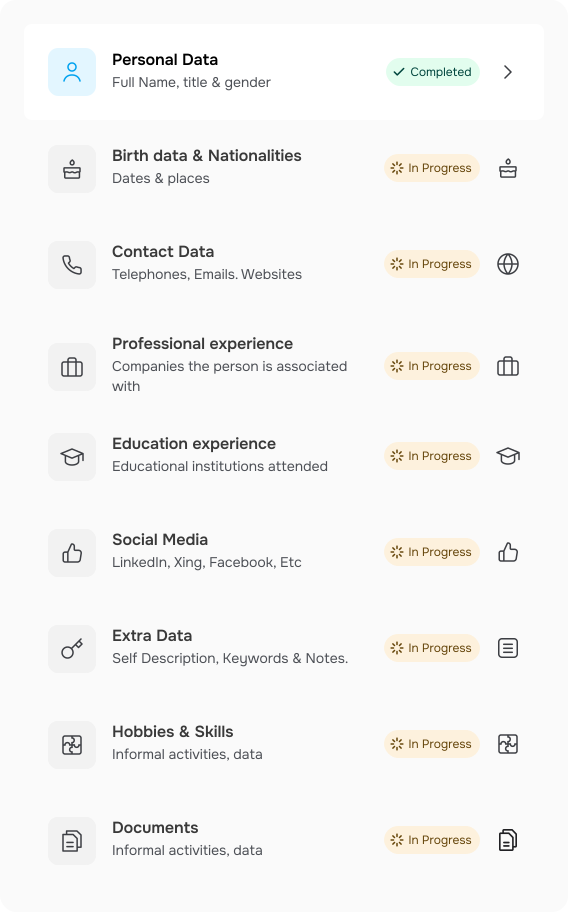
Therefore, the validation of job-relevant key data (such as academic qualifications) is a fixed part of our hiring process. For this, we work with Indicium, a European specialist provider that ensures the highest data protection standards.
The process is fully digitalized. Of course, you retain full transparency over your data.
We see this as the formal conclusion of the application process, so that we can start together on a secure foundation.
Kind regards
[Your signature]
Conclusion: Trust Through Clarity
Security and freedom depend on each other. By eliminating uncertainty in the hiring process through fact-based validation, companies create room to act. HR departments do not need to play detective; they can focus on what they do best: the cultural and professional integration of new talent.
A background check is not an expression of mistrust. It is proof that a company is professional enough to look closely.
Read more — related articles
"A company is a community founded on shared values and security. Opting for a background check can best be compared to the image of a front door. You don't lock it in the evening because you distrust the people outside. You lock it to protect the people inside."
Nabil el Berr, CEO

Diesen Artikel gelesen? Sprich 30 Min mit unserem Head of Sales.
Die hier beschriebenen Prüfungen automatisiert Indicium: DSGVO-konform, EU/Schweizer Hosting, audit-fester Trail, Reports in 8–30 Minuten. Drei Insight-Essential-Reports kannst Du ohne Kreditkarte testen.
Mabon Hein, Head of Sales · 30 Min · Keine Sales-Pitch